11 March – 6 July 2014


Vincent van Gogh (1853-1890), Portrait de l’artiste au chevalet [Portrait of the Artist at His Easel], Paris, December 1887-February1888, oil on canvas,65.1 x 50 cm © Amsterdam, Van Gogh Museum (Vincent van Gogh Foundation)

Man Ray (1890-1976), Antonin Artaud, 1926 Silver gelatine print pasted on paper, 13.1 x 7.5 cm © Centre Pompidou, MNAM-CCI, Dist. RMN-Grand Palais/ Jacques Faujour © Man Ray Trust / ADAGP, Paris 2014, © ADAGP, Paris2014
Man Ray (1890-1976), Antonin Artaud, 1926 Silver gelatine print pasted on paper, 13.1 x 7.5 cm © Centre Pompidou, MNAM-CCI, Dist. RMN-Grand Palais/ Jacques Faujour © Man Ray Trust / ADAGP, Paris 2014, © ADAGP, Paris2014
The Van Gogh / Artaud, the Man Suicided by Society exhibition focusing on Antonin Artaud's analysis of Van Gogh's work consisted of around forty paintings, a selection of Van Gogh's drawings and letters, as well as drawings by Artaud and photographs of him at the time he wrote Van Gogh / Artaud, Le suicidé de la société[Van Gogh, the Man Suicided by Society].
A few days before the opening of a van Gogh exhibition in Paris in 1947, gallery owner Pierre Loeb suggested that Antonin Artaud (1896-1948) write about the painter. He believed that as Artaud himself had spent 9 years in a psychiatric hospital, he would be well placed to write about an artist widely considered as mad.
It was the publication of extracts from Dr Beer’s book, Du démon de Van Gogh[Van Gogh’s Demon] that lit the fuse. Artaud, outraged by the psychiatric analysis, began writing in anger at theend of January 1947. Contesting Beer's theory, he challenged modern society's judgement of Van Gogh's mental health. Wishing to prevent him from uttering certain “unbearable truths”, he wrote, those who were disturbed by his painting drove him to suicide.
To support his theory, he drew on Van Gogh's paintings he discovered during two brief visits and refined his memories by consulting two heavily illustrated books and listening to Paule Thévenin reading the painter's letters to his brother Theo.
From an outstanding essya (read the whole thing!):


From an outstanding essya (read the whole thing!):
Where disorientating shapes bring out the emotion in Artaud’s drawings, Van Gogh’s portraits focus on a revolutionary use of multitudinous colour and barely concealed motion. From afar, his paintings look harmonious, learning from the pointillists that shades blend at a distance. Up close, they reveal themselves to be rough seas of flowing colour. In Self-Portrait with Easel (1888), (above) the humanity of his stare, with his eyes as deep wells, contrasts with the agitated brush strokes that form the shape, texture and contours of his coat and continue on to his skin. By the time of his self-portrait of the following year, the forms have changed dramatically. The blues swim and swirl. There is little to distinguish his clothes from his environment. His face and stare are bold and defined suggesting a much sturdier physiognomy, yet the world around him is in unstoppable flux. Though it suggests our faces change radically as our moods do, there is also more than a stark suggestion that the artist is suffering from malnutrition.
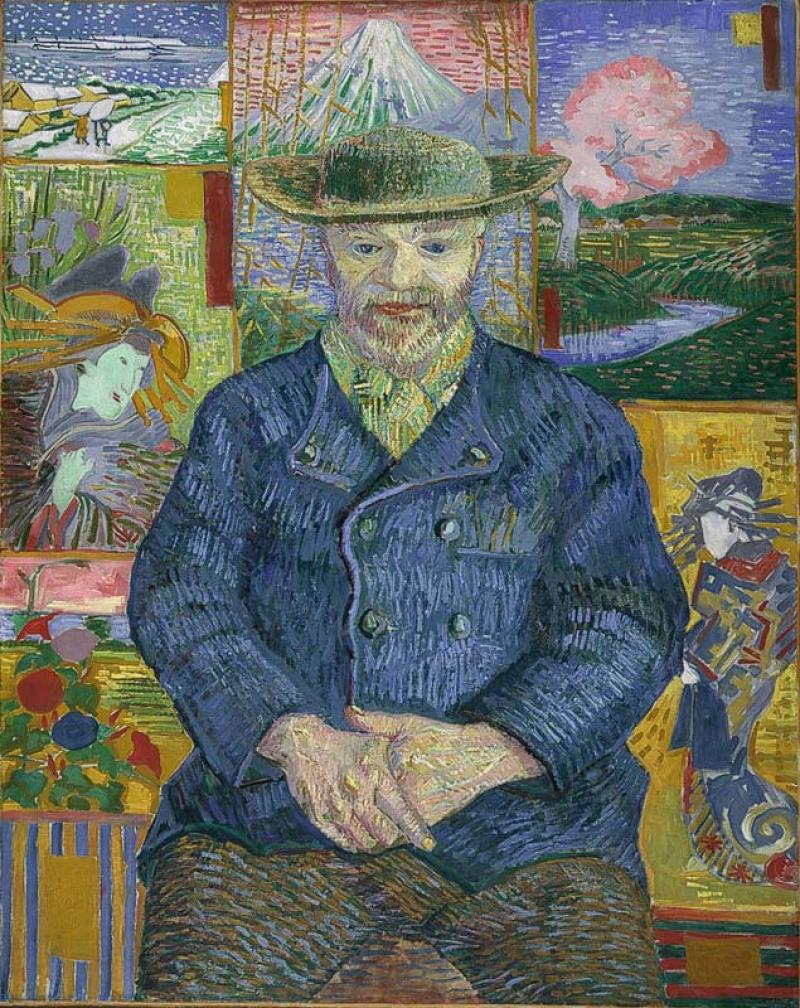
Even the Portrait of Père Tanguy (1887), often taken at face value as a tranquil pseudo-Buddhist pose, seems skewed and on edge. The fact that Van Gogh was aiming so desperately at serenity suggests something was manifestly not right. In Artaud, the unease is explicit; in Van Gogh it is implicit.
Artaud was right to identify this tendency in his would-be mentor. “For a long time, pure linear painting drove me mad until I met Van Gogh, who painted neither lines nor shapes, but inert things in nature as if they were having convulsions,” he wrote. This would be expected in a place of hedonistic abandon such as

The Dance Hall in Arles (1888), much less in the placid wallpapered surrounds of his Augustine Roulin portrait, but it is there still. Even painting landscapes, especially painting landscapes, these “convulsions” are evident. As attempts at tranquillity, they are failures just as much as they are monumental triumphs of art. The whirling, churning effect of the wind on the clouds, trees and wheat fields

(best shown in Country Road in Provence By Night, 1890) is wonderful until we consider that those days may have been entirely free from any breeze.
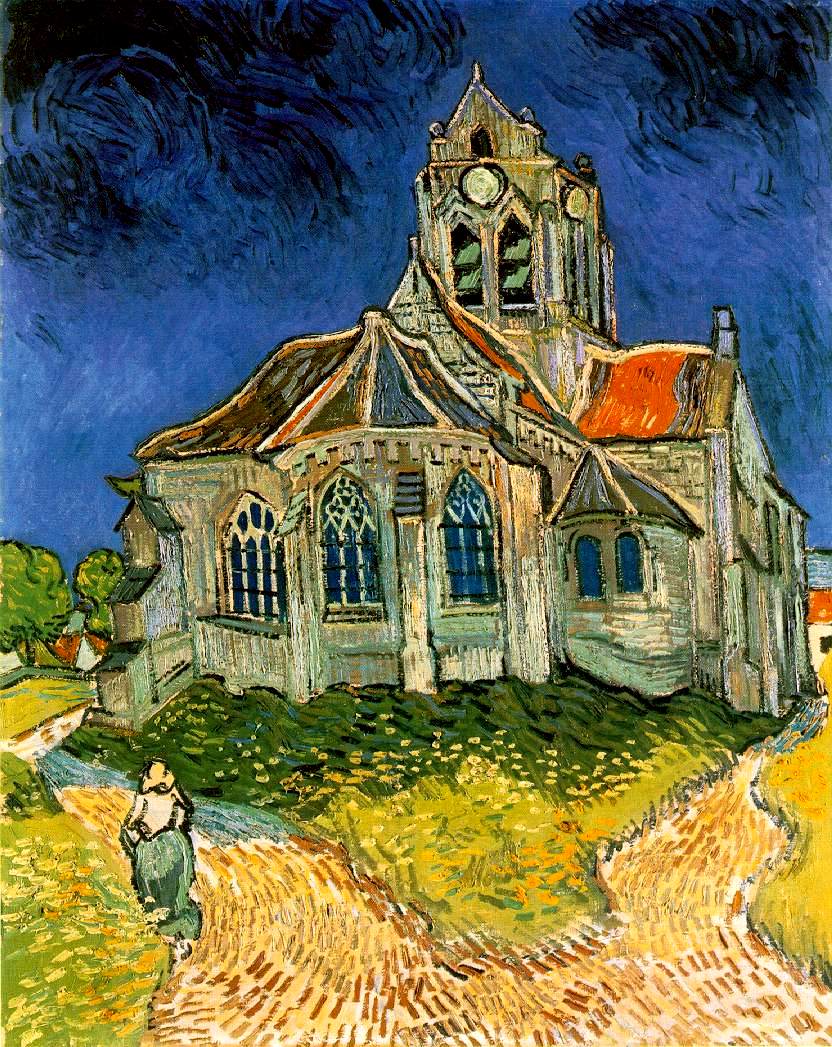
After all, Van Gogh’s Church at Auvers (1890) is similarly sublimely warped. What hope did mere humans have when the mind could do this to cathedrals of solid stone?
Nhận xét
Đăng nhận xét