The Frist Center for the Visual Arts presents Telling Tales: Stories and Legends in 19th-Century American Art from February 27–June 7, 2015, in the Center’s Upper-Level Galleries. The exhibition features paintings and sculptures that recount stories relating to American cultural aspirations and everyday life throughout the 19th century. Narrative landscapes by Thomas Cole and Asher B. Durand of the Hudson River School, genre scenes by William Sidney Mount and Francis W. Edmonds and sculptures by John Rogers are among the highlights of the exhibition.
Assembled from the collection of the New-York Historical Society, Telling Tales integrates genre, historical, literary and religious subjects—through styles ranging from Neoclassicism to Realism—to paint a vivid portrait of American art and life during the country’s most formative century. The exhibition is organized into six sections: “American History Painting,” “English Literature and History,” “Importing the Grand Manner,” “Genre Paintings,” “Economic, Social, and Religious Division” and “Picturing the Outsider.” Frist Center Chief Curator Mark Scala says, “The works in Telling Tales show a culture in the process of defining its ideals and values. They offer an overview of the complex tastes, aspirations, and internal contradictions that marked the first full century of this new democracy.”
In Europe, historical events and figures were considered the most important subjects in art. This tradition influenced American artists who sought to shape the nation’s sense of shared knowledge, pride and identity by painting leading historical figures and momentous events. Telling Tales begins with the section “American History Painting.” In Rembrandt Peale’s George Washington (1853), the artist aimed to capture a perfect likeness of the person who most exemplified American ideals. The exhibition continues with works that imaginatively reconstruct stories relating to America’s settlement, expansion and conflicts.
America’s language and culture were deeply rooted in English tradition, which is reflected in the second section of the exhibition. “English Literature and History” showcases works inspired by British aristocracy and popular writers, including Shakespeare, who was particularly admired in America. The subjects of many British dramas related subtly to contemporary issues in America, such as political and religious strife and slavery. A related section, “Importing the Grand Manner,” includes works created in the high styles of European art: the Baroque, the Neoclassical, and the Romantic. Believing that American taste was in need of elevation, many artists went to Europe to study the Old Masters and attend art academies where they could learn how to best convey themes of history, mythology and religion.
While some American artists studied abroad with the intention of bringing European refinement to their own country, there was a growing resistance to European elitism in America. Mr. Scala notes, “For such artists, this infatuation with European culture reinforced elitist attitudes about connoisseurship and class; it was out of step with the needs and interests of an egalitarian society.” The artists reinforced what they felt was a distinctly American identity, expressed through both the everyday subject matter and a style that was simple and direct.
Works in the section “Genre Paintings” focus on the lives of ordinary people, often living in rural settings. With a straightforward realism, the paintings convey the importance of farm work, family, faith and commerce. Artists often employed the use of stock characters, such as devout parents, politically engaged yeomen, roaming peddlers and slick Yankee traders.

For example, William Sidney Mount’s Bargaining for a Horse (1835),
in which two men are shown as they shrewdly negotiate the sale of a horse, was described by a contemporary reviewer as “an image of pure Yankeeism.” These genre paintings were more than simply slices of everyday life. As Mr. Scala explains, “While they appear to be charmingly uncomplicated, genre paintings often contained symbolic messages about topical matters of politics, religion and economics. These meanings would have been readily understood by the 19th century viewer but may be difficult for us to perceive if we do not know the political and historical backdrop.”
Throughout the 19th century, large numbers of people seeking work moved from rural areas and other countries into large manufacturing centers like New York, Boston, and Philadelphia. Art included in the section “Economic, Social, and Religious Division” reveals a growing awareness of the difficulties encountered by this expanding population of working-class and poor people.
Paintings and sculptures in the final section of the exhibition, “Picturing the Outsider,” hint at the even harsher realities faced by the most marginalized minorities, Native Americans and African Americans.
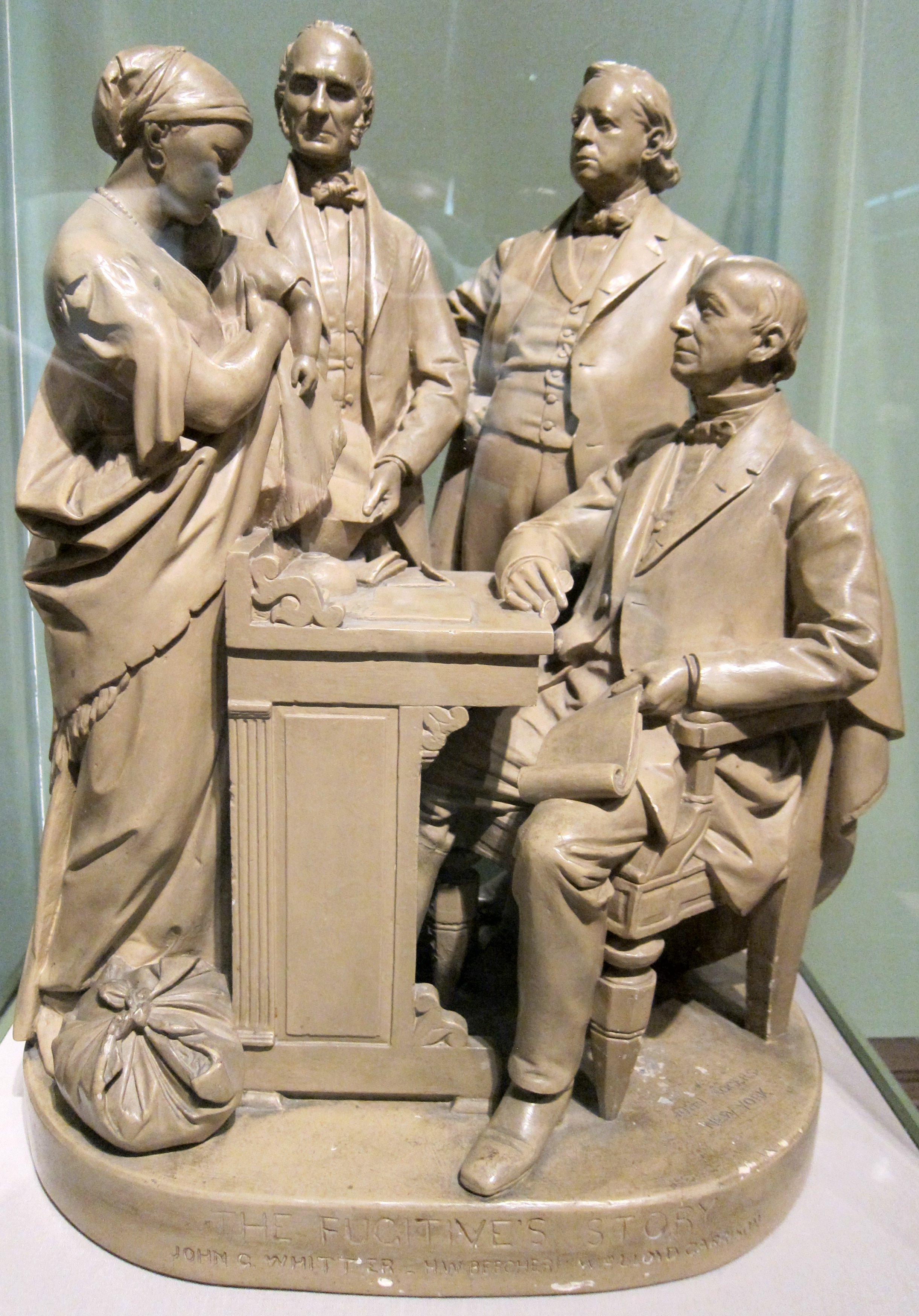
John Rogers’ bronze sculpture The Fugitive’s Story (1869)
reverently memorializes three prominent abolitionists with respect to their struggle to help slaves gain their freedom. Others were more ambiguous in their portrayal of race in America.

Eastman Johnson’s Negro Life at the South (1859)
shows slaves living in decrepit conditions but enjoying their leisure time, perhaps reinforcing the belief among slaveholders and other racist audiences that the treatment of slaves was fairly benign. “Such works tell how a culture’s perceptions—and misperceptions—are reinforced by art,” says Mr. Scala, “reminding us that as we explore our artistic heritage, it is important to take our ancestors’ biases and cultural blinders into account. It will likely be the same for us when our descendants look back on the 21st century.”
Exhibition Credit
Telling Tales: Stories and Legends in 19th-Century American Art is adapted from Making American Taste: Narrative Art for a New Democracy, organized by the New-York Historical Society.

Louis Lang (1814–1893), Return of the 69th (Irish) Regiment, N.Y.S.M. from the Seat of War, 1862-1863. Oil on canvas. New-York Historical Society, Gift of Louis Lang, 1886.3. Photo courtesy Williamstown Art Conservation Center, 2011
Nhận xét
Đăng nhận xét