Sotheby’s London Impressionist & Modern Art Evening Sales 2017
Joan Miró’s Femme et oiseaux

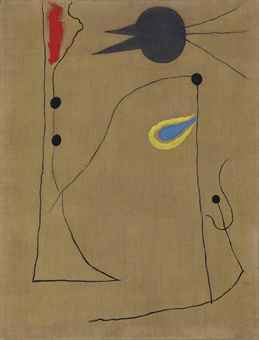
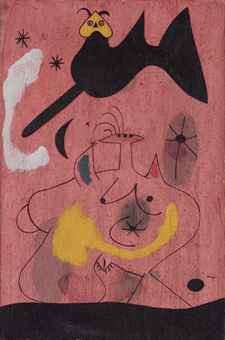
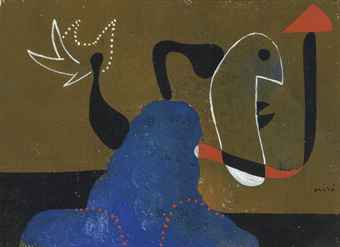
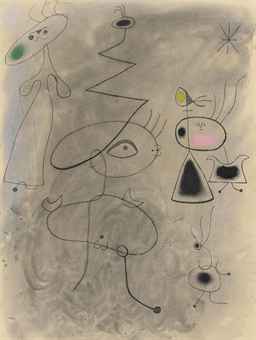
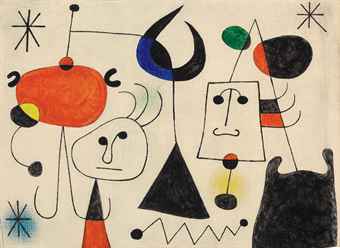
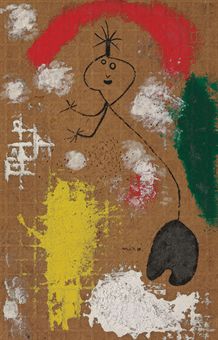
A mesmerising example of Joan Miró’s celebrated lyricism and freedom of expression during the Second World War, Femme et oiseaux is the eighth in the extraordinary series of twenty-three Constellations that are considered the masterpieces of his prolific oeuvre. At the time of painting, Miró was deeply anguished about the political situation in both Spain and France and profoundly concerned about both countries’ future. In this work, a number of vibrant forms join together in frenzied activity to create a united cosmic vision and it was in this otherworldly subject-matter that the artist found a much needed escape. The painting does not even hint at the relentless progress of the forces of oppression, instead the artist looks to the beauty and poetry of the world that still prevailed. Appearing on the market for the first time in thirty years, the masterful Femme et oiseaux will lead Sotheby’s Impressionist & Modern Art Evening Sale on 21 June in London.
Thomas Bompard, Head of Sotheby’s London Impressionist & Modern Art Evening Sales, said: “It’s tempting to reference the stars aligning this season, with the rarity of offering a painting from a body of work that has such as mythical status. The universal appreciation for Miro’s Constellation series - not only as Miro’s greatest achievement but also as one of the most groundbreaking and celebrated bodies of work by any 20th century artist - comes into sharp focus when standing in front of Femme et oiseaux. We have no doubt that in the minds of collectors from around the world this is an exceptional opportunity – the last time one of the Constellations was sold at auction was at Sotheby’s in 2001.”
A JOURNEY OF CREATION & RESISTANCE
Over the course of almost two years, from January 1940 to September 1941, Miró worked on the Constellations with a seamless devotion and unrelenting concentration that distracted him from the hostile political climate of war-torn France and later Spain. Femme et oiseaux is one of the first ten compositions the artist executed during his exile in France following the outbreak of the Spanish Civil War. Miró was living in the village of Varengeville on the coast of Normandy, where he could work in tranquil seclusion whilst also being inspired by the dramatic cliffs and constantly changing sky and seascape.
In May 1940, only weeks after Miró executed this work, Germany invaded Paris and the artist fled to Spain. In a letter to Roland Penrose, the artist wrote about the tumultuous journey through war-torn France that interrupted the execution of the series: taking the last train, his wife held the hand of his young daughter, “while I carried under my arm the satchel with a series of already-finished Constellations and the sheets of paper which would be used for the complete series”. Barely managing to leave France, Miró settled in his wife’s town of Palma de Mallorca, where he completed the next set of Constellations. The small size of the works is an indication that Miró knew that he might have to be on the move at any moment, and so the series was all portable.
The delicate technique that Miró used was to brush, scrape, polish, moisten and rub the ground of the paper, creating the gradated and textured pockets of light and dark that convey the celestial boundlessness in which the objects float. Interspersed amidst the crescent moon, suns, comets and stars are pseudo-sexual amoeboid shapes and fragmented body parts. The picture is then enlivened with swirling lines that shape and direct the flow of energy. Jacques Dupin wrote of the Constellations, “never before has his ‘touch’ been so delicate or so subtle in the sensual animation of pigments”.
UNVEILING IN AMERICA & LEGACY
The works were an example of resistance – expressing a ‘spirit of revolt’ through the unconstrained freedom of the composition. The French poet André Breton, considered the founder of Surrealism, wrote about the series that “a great stroke of fortune decreed that, shortly after the allied landing, Miró’s Constellations comprised the first message relating to art to reach America from Europe since the beginning of the war. It would be impossible to overestimate the depth of the gap that this message filled”.
Throughout this time, Miró was aware that he was producing something special – writing, “I feel that it is one of the most important things I have done” – yet the series was hidden away until 1944 when he began making arrangements for the group to be revealed in public. First intended for The Museum of Modern Art in New York, twenty-two of the works arrived in the United States in July 1944 – with one having been kept for the artist’s wife. However, once they arrived, MoMA was not able to cover the significant cost of shipping in the context of the war, Miró’s New York dealer Pierre Matisse took responsibility for the entire group. The resulting exhibition in January – February 1945 caused a sensation in New York and was universally praised. Reviewing the show for the New York Sun, a critic wrote that “it is impossible to pick out the best picture in the display because all of the twenty-two pictures are the best”.
The legacy of Miró’s Constellations in art is profound, particularly his impact on American art. The artist set a precedent for Jackson Pollock and his use of a starry sky as a subject for avantgarde abstract expressionist paintings, with Pollock’s own Constellation painted in 1946. Although they were separated from each other by geography and war, Miró was also on a parallel course with Alexander Calder – who, at the Pierre Matisse Gallery, had introduced a new category of work Constellaciónes in 1943.

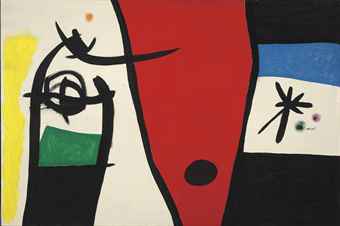
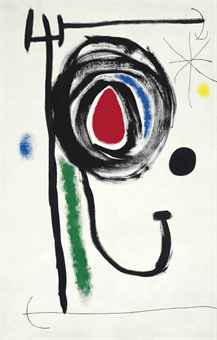
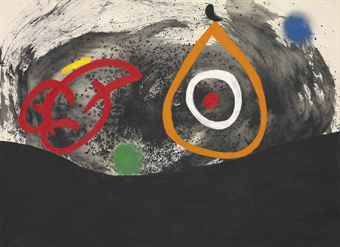
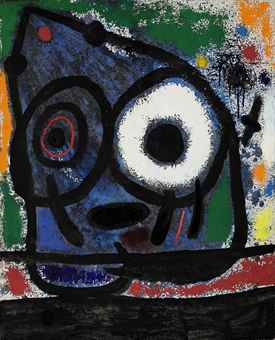
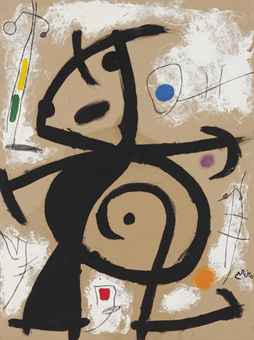
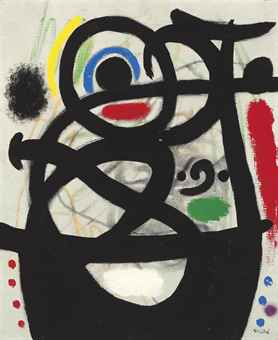
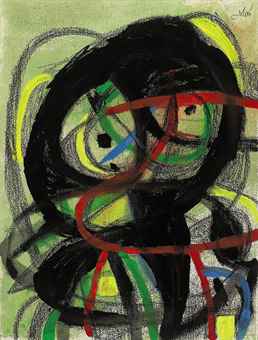
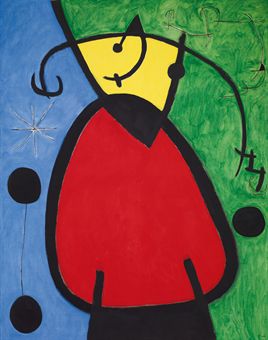
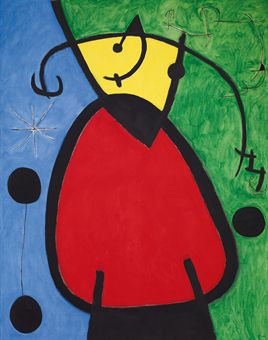
Painted in March 1968, Femme et oiseaux dans la nuit (Woman and Birds in the Night) by Joan Miró (1893-1983) is a major large-scale painting of one of the artist’s favourite subjects, made for an important travelling retrospective exhibition of his work held at the Fondation Maeght in Saint-Paul-de-Vence, the Antic Hospital de la Santa Creu in Barcelona and the Haus der Kunst in Munich between 1968 and 1969 (estimate: £3-5 million). Of all these venues, it was Miró’s exhibition in Barcelona, his first in Spain for over fifty years, which was to prove the most lastingly important as it led directly to the establishment of the Miró Foundation there seven years later. Femme et oiseaux dans la nuit is one of several paintings on the poetic theme of women, birds and the night that Miró made in the mid-1960s, at a time when he was pursuing the joint influences of recent American painting and of Japanese calligraphy on his own uniquely poetic, instinctive and gestural style of painting.
Sotheby’s London Surrealist Art Evening Sale on 5 February 2013
Joan Miró’s Femme et oiseaux

A mesmerising example of Joan Miró’s celebrated lyricism and freedom of expression during the Second World War, Femme et oiseaux is the eighth in the extraordinary series of twenty-three Constellations that are considered the masterpieces of his prolific oeuvre. At the time of painting, Miró was deeply anguished about the political situation in both Spain and France and profoundly concerned about both countries’ future. In this work, a number of vibrant forms join together in frenzied activity to create a united cosmic vision and it was in this otherworldly subject-matter that the artist found a much needed escape. The painting does not even hint at the relentless progress of the forces of oppression, instead the artist looks to the beauty and poetry of the world that still prevailed. Appearing on the market for the first time in thirty years, the masterful Femme et oiseaux will lead Sotheby’s Impressionist & Modern Art Evening Sale on 21 June in London.
Thomas Bompard, Head of Sotheby’s London Impressionist & Modern Art Evening Sales, said: “It’s tempting to reference the stars aligning this season, with the rarity of offering a painting from a body of work that has such as mythical status. The universal appreciation for Miro’s Constellation series - not only as Miro’s greatest achievement but also as one of the most groundbreaking and celebrated bodies of work by any 20th century artist - comes into sharp focus when standing in front of Femme et oiseaux. We have no doubt that in the minds of collectors from around the world this is an exceptional opportunity – the last time one of the Constellations was sold at auction was at Sotheby’s in 2001.”
A JOURNEY OF CREATION & RESISTANCE
Over the course of almost two years, from January 1940 to September 1941, Miró worked on the Constellations with a seamless devotion and unrelenting concentration that distracted him from the hostile political climate of war-torn France and later Spain. Femme et oiseaux is one of the first ten compositions the artist executed during his exile in France following the outbreak of the Spanish Civil War. Miró was living in the village of Varengeville on the coast of Normandy, where he could work in tranquil seclusion whilst also being inspired by the dramatic cliffs and constantly changing sky and seascape.
In May 1940, only weeks after Miró executed this work, Germany invaded Paris and the artist fled to Spain. In a letter to Roland Penrose, the artist wrote about the tumultuous journey through war-torn France that interrupted the execution of the series: taking the last train, his wife held the hand of his young daughter, “while I carried under my arm the satchel with a series of already-finished Constellations and the sheets of paper which would be used for the complete series”. Barely managing to leave France, Miró settled in his wife’s town of Palma de Mallorca, where he completed the next set of Constellations. The small size of the works is an indication that Miró knew that he might have to be on the move at any moment, and so the series was all portable.
The delicate technique that Miró used was to brush, scrape, polish, moisten and rub the ground of the paper, creating the gradated and textured pockets of light and dark that convey the celestial boundlessness in which the objects float. Interspersed amidst the crescent moon, suns, comets and stars are pseudo-sexual amoeboid shapes and fragmented body parts. The picture is then enlivened with swirling lines that shape and direct the flow of energy. Jacques Dupin wrote of the Constellations, “never before has his ‘touch’ been so delicate or so subtle in the sensual animation of pigments”.
UNVEILING IN AMERICA & LEGACY
The works were an example of resistance – expressing a ‘spirit of revolt’ through the unconstrained freedom of the composition. The French poet André Breton, considered the founder of Surrealism, wrote about the series that “a great stroke of fortune decreed that, shortly after the allied landing, Miró’s Constellations comprised the first message relating to art to reach America from Europe since the beginning of the war. It would be impossible to overestimate the depth of the gap that this message filled”.
Throughout this time, Miró was aware that he was producing something special – writing, “I feel that it is one of the most important things I have done” – yet the series was hidden away until 1944 when he began making arrangements for the group to be revealed in public. First intended for The Museum of Modern Art in New York, twenty-two of the works arrived in the United States in July 1944 – with one having been kept for the artist’s wife. However, once they arrived, MoMA was not able to cover the significant cost of shipping in the context of the war, Miró’s New York dealer Pierre Matisse took responsibility for the entire group. The resulting exhibition in January – February 1945 caused a sensation in New York and was universally praised. Reviewing the show for the New York Sun, a critic wrote that “it is impossible to pick out the best picture in the display because all of the twenty-two pictures are the best”.
The legacy of Miró’s Constellations in art is profound, particularly his impact on American art. The artist set a precedent for Jackson Pollock and his use of a starry sky as a subject for avantgarde abstract expressionist paintings, with Pollock’s own Constellation painted in 1946. Although they were separated from each other by geography and war, Miró was also on a parallel course with Alexander Calder – who, at the Pierre Matisse Gallery, had introduced a new category of work Constellaciónes in 1943.
‘After the Nazi invasion of France and Franco’s victory, I was sure they wouldn’t let me go on painting, that I would only be able to go to the beach and draw in the sand or draw figures with the smoke from my cigarette. When I was painting the Constellations I had the genuine feeling that I was working in secret, but it was a liberation for me in that I ceased thinking about the tragedy all around me. While I was working, my suffering stopped… I gave the paintings very poetic titles because that was the line I had chosen to take and because the only thing left for me in the world then was poetry’--Joan Miró
Christie’s The Art of the Surreal Evening Sale on Tuesday 2 February 2016
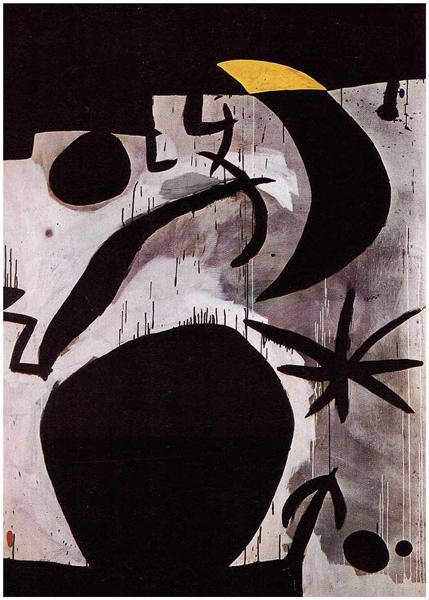
Painted in March 1968, Femme et oiseaux dans la nuit (Woman and Birds in the Night) by Joan Miró (1893-1983) is a major large-scale painting of one of the artist’s favourite subjects, made for an important travelling retrospective exhibition of his work held at the Fondation Maeght in Saint-Paul-de-Vence, the Antic Hospital de la Santa Creu in Barcelona and the Haus der Kunst in Munich between 1968 and 1969 (estimate: £3-5 million). Of all these venues, it was Miró’s exhibition in Barcelona, his first in Spain for over fifty years, which was to prove the most lastingly important as it led directly to the establishment of the Miró Foundation there seven years later. Femme et oiseaux dans la nuit is one of several paintings on the poetic theme of women, birds and the night that Miró made in the mid-1960s, at a time when he was pursuing the joint influences of recent American painting and of Japanese calligraphy on his own uniquely poetic, instinctive and gestural style of painting.
Sotheby’s London Surrealist Art Evening Sale on 5 February 2013

Highlighting the sale is Le fermier et son épouse (, est. £5.5-7.5 million), an intense and brilliantly coloured painting by Joan Miró.The work was executed in 1936, a time when the artist was reaching wide-spread international recognition, with his works participating in now legendary Surrealist exhibitions including the International Surrealist Exhibitionin London and Fantastic Art, Dada & Surrealism at the Museum of Modern Art in New York. The painting depicts a Catalan farmer and his wife, surrounded by the landscape of Montroig and farm animals. Summarising the significance of this farm when working on a painting depicting it in 1928, Miró remarked that the work was: “a résumé of my entire life in the country. I wanted to put everything I loved about the country into that canvas - from a huge tree to a tiny little snail. I don't think it makes sense to give more importance to a mountain than an ant (but landscape artists just can't see that).”
The powerful composition Le fermier et son épouse from one of the most turbulent periods of Miró's career was painted in the lead-up to the outbreak of the Spanish Civil War inthe summer of that year. For many decades the painting was in the collection of the great American film director Billy Wilder (of Some Like It Hot and Sunset Boulevard fame). The work was not seen in public until 1989, when Billy Wilder’s collection was sold at auction in New York.
Also in the sale:

Also in the sale:

Joan Miró
LOT SOLD. 8,441,250 GBPSotheby’s London Impressionist & Modern Art Evening Sale in June 2012 sale saw a record price achieved for any record price achieved for any record price achieved for any record price achieved for any Surrealist work of art, and any work by Joan Miro with the sale of

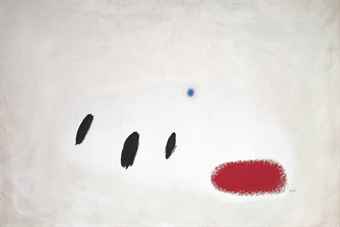
Peinture (Étoile bleue) for £23.6 million (pre-sale estimate £15-20 million)
Sotheby’s Evening sale of Impressionist and Modern Art, 8th February 2011

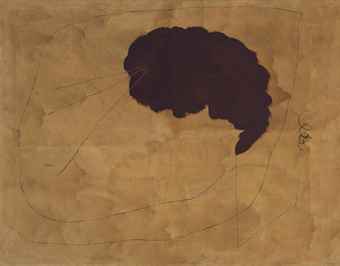
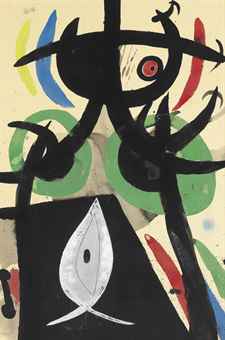
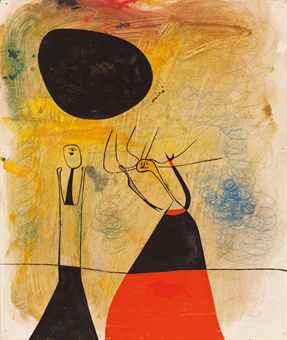
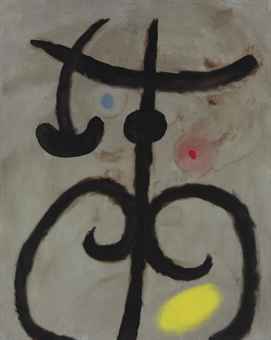
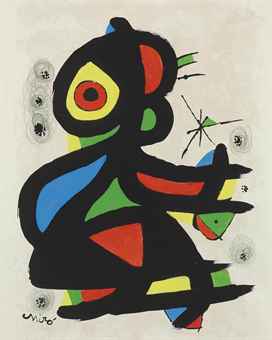
Joan Miró is represented in the sale with a striking example of the artist’s late works, Femme, 1978 (est: £900,000-£1.2 million), which features the characteristic iconography that occupied the artist throughout his career. For Miró, women, birds, stars, the moon, the sun, night and dusk formed a poetic language, and the present work shows his style verging between figuration and abstraction. While taking a recognisable image as his starting point, the artist builds his composition using a pictorial lexicon of signs and symbols.
Sotheby's 2014

Peinture (Étoile bleue) for £23.6 million (pre-sale estimate £15-20 million)
Sotheby’s Evening sale of Impressionist and Modern Art, 8th February 2011

Joan Miró is represented in the sale with a striking example of the artist’s late works, Femme, 1978 (est: £900,000-£1.2 million), which features the characteristic iconography that occupied the artist throughout his career. For Miró, women, birds, stars, the moon, the sun, night and dusk formed a poetic language, and the present work shows his style verging between figuration and abstraction. While taking a recognisable image as his starting point, the artist builds his composition using a pictorial lexicon of signs and symbols.
Sotheby's 2014

Joan Miró
LOT SOLD. 2,285,000 USD
Joan Miró
Estimate 4,000,000 — 6,000,000 USD

Joan Miró
LOT SOLD. 581,000 USD 
Christie's 2014


Christie's 2013



Christie's 2012


Christie's 2011
·
Christie's 2010
Christie's 2008

Christie's 2007
Nhận xét
Đăng nhận xét