January 30–July 19, 2015
First exhibition at the Gallery dedicated to James Abbott McNeill Whistler (1834–1903) focuses on the artist’s exquisite and masterful etchings
Whistler in Paris, London, and Veniceexamines the life and artistic development of James Abbott McNeill Whistler (1834–1903), one of the most celebrated artists of the 19th century, through the lens of three of his earliest and most innovative sets of etchings, the so-called French, Thames, and Venice Sets. The sets are representative of three important periods in Whistler’s life: as a student in Paris, absorbing the lessons of his Realist contemporaries and the Old Masters; as an emerging artist in London, forging a name for himself as an etcher; and as a well-known artist and teacher in Venice, trying to recover his reputation and fortune following a devastating bankruptcy. Over 100 objects from the Yale University Art Gallery’s permanent holdings, including etchings of Venice by Mortimer Menpes, one of Whistler’s most devoted pupils, and several lively works by Whistler’s contemporaries Édouard Manet, Francis Seymour Haden, Childe Hassam, and Joseph Pennell, are joined by more than a dozen works from the collection of the Yale Center for British Art, providing further perspective on Whistler’s life and influence.
Exhibition Overview
Born in Lowell, Massachusetts, in 1834, raised in Saint Petersburg, Russia, and educated for three years at the United States Military Academy at West Point, Whistler had a nomadic and cultured upbringing. During these formative years, he realized that he wanted to be an artist and began training in drawing, first at the Imperial Academy of Fine Arts in Russia and later at West Point. He then studied etching at the U.S.Coast Survey in Washington, D.C., before dedicating himself full time to art at age twenty-one and leaving for Paris in 1855. Though he never returned to the country of his birth, Whistler always identified as an American and reveled in his status as an outsider, in both nationality and artistic output.
As Whistler matured as an artist, he began to cast himself as the “mercurial butterfly”—his signature soon resembled a stylized version of the insect—and to create what he dubbed “art for art’s sake.” The works on view showcase this artistic evolution and represent three major periods in Whistler’s life. The first part of the exhibition focuses on his Parisian stay and the influences and artists he encountered there. Among the works is a selection of etchings from the series Twelve Etchings after Nature(1857–58; published 1858), better known as the French Set, Whistler’s first published series and the first art that he aggressively marketed. These etchings reveal his commitment to working directly from nature and his close study of works by Diego Velázquez, Rembrandt van Rijn, and Johannes Vermeer. In Paris, Whistler befriended artists associated with the Realist and Impressionist movements, including Edgar Degas, Henri Fantin-Latour, and Édouard Manet. Works by some of Whistler’s associates are also on view in the exhibition.
In 1859 Whistler moved to London, where he forged a name for himself as an etcher and celebrity of the art world. The foundation of the second part of the exhibition is a complete set of A Series of Sixteen Etchings of Scenes on the Thames and Other Subjects(1859–71; published 1871), commonly called the Thames Set, which established Whistler’s reputation as an etcher par excellence. Its imagery consists almost exclusively of the changing urban waterscapes of the unsavory commercial districts along the Thames River, where Whistler lived and worked during his earliest years in London.
Whistler’s etching sojourn in late 1879 to Venice, where he tried to recover his reputation and fortune following a devastating bankruptcy, is the focus of the third section of the exhibition, which features selections from the First Venice Set and Second Venice Set(1879–80; published 1880 and 1886, respectively). In some of these extraordinary prints, Whistler captured the landscape dematerializing behind shrouds of soft mist tinged by fading twilight, as he had done earlier in a series of oil paintings known as the Nocturnes, one of several abstract terms Whistler adopted to refer to the mood of a painting rather than its subject. While in Venice, he befriended a small group of expatriate artists, whose work is featured alongside Whistler’s in this section of the exhibition.
The French, Thames, and Venice Sets are important milestones in the Etching Revival, which flourished in Britain and abroad during the Victorian era and absorbed Whistler and members of his circle. The final section of the exhibition explores the influence of Whistler’s etchings on his students and contemporaries—including Childe Hassam, John Marin, Mortimer Menpes, and Joseph Pennell—who carried on the etching tradition and delighted in the expressive potential of the medium.
Also on view are two of Whistler’s original copper plates, as well as other materials that illuminate the artist’s mastery of etching and of printing processes and techniques. Whistler often reworked his exquisitely etched plates, varied his application of the inks, and alternated paper types, making every impression a unique work of art.
“It is splendid that the Gallery’s first exhibition of Whistler’s art will not only focus on his three superlative series of etchings, made in Paris, London, and Venice—some from our own collection and others generously lent by the Yale Center for British Art—but will also greatly sharpen and deepen our understanding of the artist by illuminating the very different circumstances under which he made each of these famous sets,” states Suzanne Boorsch, the Robert L. Solley Curator of Prints and Drawings.
Heather Nolin, curator of the exhibition, expands on this: “Most audiences, when they think of Whistler, likely bring to mind the large painted portrait of his beloved mother, Anna. Yet, it was Whistler’s etchings that first made him famous, and they remain central to understanding his genius and enduring legacy,” states Nolin. “Whistler had a keen aesthetic sense, and found beauty in the unlikeliest of places, such as the seedy docklands along the Thames River. Even places already renowned for their beauty, such as the city of Venice, were transformed by Whistler into more breathtakingly sublime versions of themselves. His genius combined natural artistic abilities and an eye for form and composition with technical virtuosity in etching and printing.”
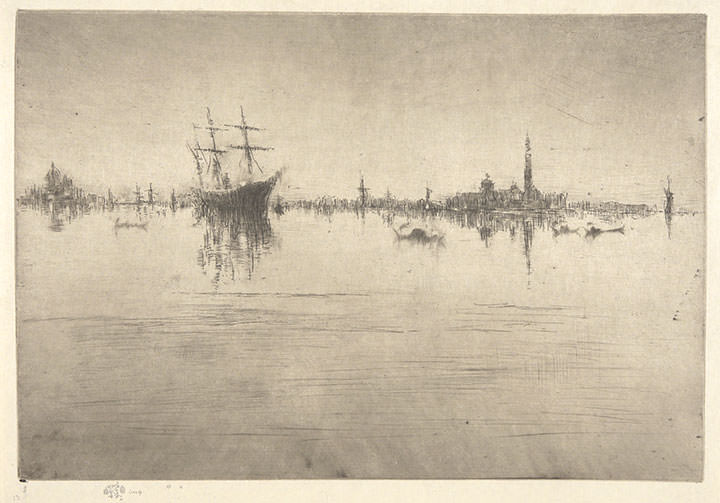
James Abbott McNeill Whistler, Nocturne, from the First Venice Set , 1879–80. Etching and drypoint on wove paper, 8 7/8 x 12 1/2 in. (22.5 x 31.8 cm). Yale University Art Gallery, Gift of Leonard C. Hanna, Jr., Class of 1913
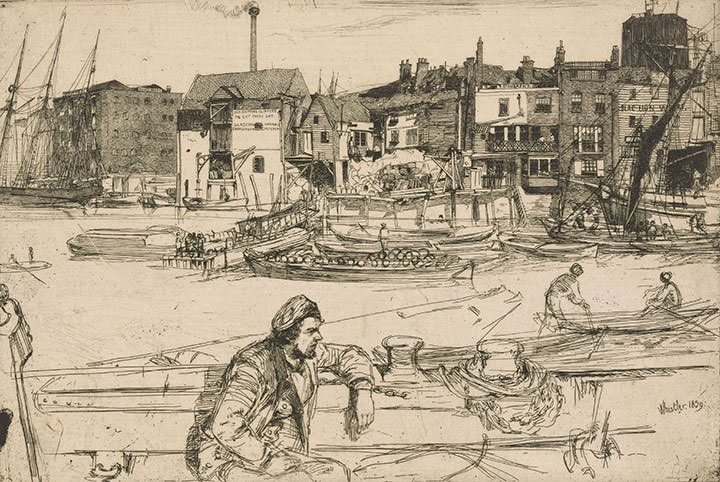
James Abbott McNeill Whistler, Black Lion Wharf , from the Thames Set , 1859. Etching on Asian paper, 8 1/8 x 11 3/8 in. (20.6 x 28.9 cm). Yale University Art Gallery, Gift of J. Watson Webb, b.a. 1907, and Electra Havemeyer Webb

James Abbott McNeill Whistler, The Piazzetta , from the First Venice Set , 1879–80. Etching and drypoint on laid paper, 10 1/16 x 7 1/16 in. (25.5 x 18 cm). Yale University Art Gallery, Everett V. Meeks, b.a. 1901, Fund

James Abbott McNeill Whistler, La marchande de moutarde (The Mustard Seller), from the French Set , 1858. Etching on chine collé, 17 x 12 in. (43.2 x 30.5 cm). Yale University Art Gallery, The Walter R. Cal - lender, b.a. 1894, Memorial Collection, Gift of Ivy Lee Callender
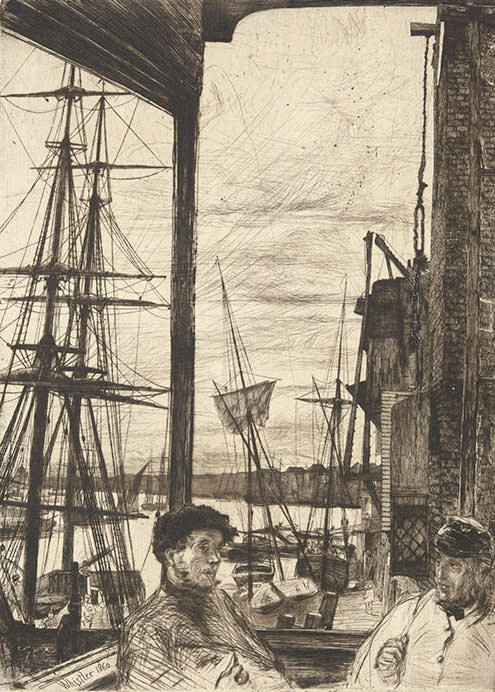
James Abbott McNeill Whistler, Thames Police (Wapping Wharf), from the Thames Set , 1859 (printed 1864). Etching on laid paper, 16 x 10 3/4 in. (40.6 x 27.3 cm). Yale University Art Gallery, Gift of J. Watson Webb b.a. 1907 and Electra Havemeyer Webb

James Abbott McNeill Whistler, The Unsafe Tenement from the French Set , 1858. Etching on laid paper recycled from an antique book, 8 x 10 1/2 in. (20.3 x 26.7 cm). Yale University Art Gallery, Gift of Robert W. Carle, b.a. 1897
Nhận xét
Đăng nhận xét