CHAGALL THROUGH THE DECADES
SOTHEBY’S TEL AVIV, APRIL 9-12, 2012
The dreamlike world of Marc Chagall, occupied by flying lovers, musicians, circus figures, flowers and animals is a place of intense personal symbolism that is utterly unique. At the same time, his works are deeply rooted in his Jewish and Russian background; indeed, the critic Robert Hughes called him “the quintessential Jewish artist of the twentieth century”. In his Jewish heritage and his lifelong connection with Israel, Chagall found inspiration, friendship, support, patronage, and a deep appreciation among collectors that continues to grow to this day.
Many of Chagall’s most important projects were conceived or executed in Israel. His first visit, in 1931, followed a commission from the legendary Parisian dealer Ambroise Vollard for a series of illustrations to the Bible. The vivid impression left on him by the country’s landscape and light can be seen not only in these etchings but throughout his oeuvre. By the time Chagall returned to Israel in 1951 for a major retrospective, his work was already widely recognised. In 1962 he attended the unveiling of his twelve stained-glass windows for the synagogue of the Hebrew University’s Hadassah Medical School in Jerusalem; and in 1963 he visited again to develop the iconography of the decoration for the new Knesset building.
During his final visit to Israel in 1977 the 90-year old Chagall received two awards, an honorary doctorate from the Weizmann Institute of Science, and the title ‘Worthy of Jerusalem’, conferred on him by the city of Jerusalem. These awards were testament to a deep reciprocal relationship that had both inspired Chagall throughout his life and greatly enriched the country’s artistic heritage. Sotheby’s current selling exhibition ‘Chagall Through the Decades’, is the latest expression of that relationship, allowing visitors to Tel Aviv to trace seven decades of this great modern master’s oeuvre.
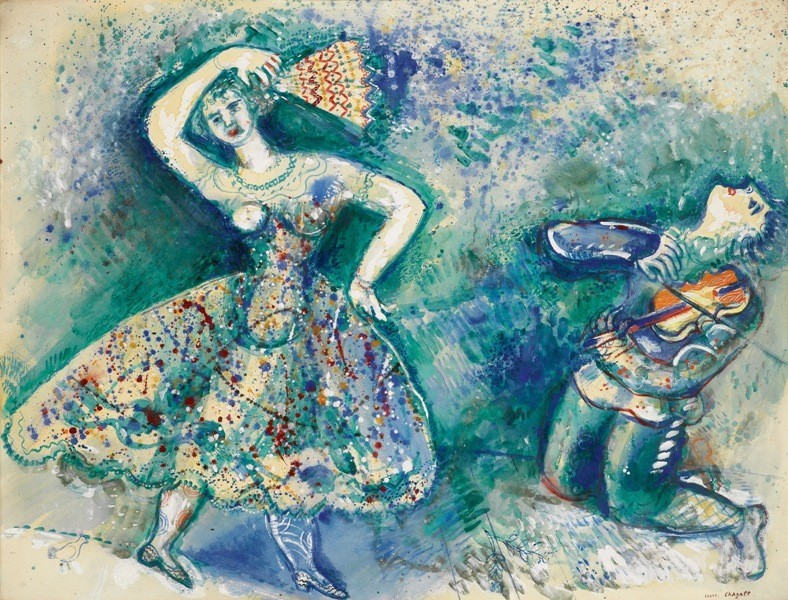
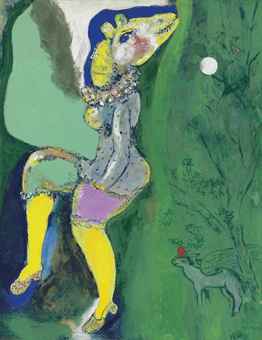
MARC CHAGALL LA DANSE
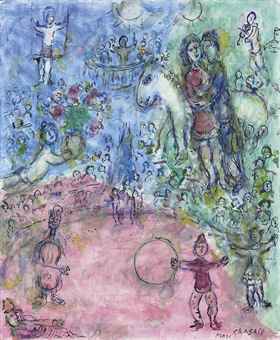
Executed just one year after Marc Chagall founded the Association des Peinteurs-Gravures in Paris in 1927, the present work is a wonderful example of Chagall’s innovative use of pigment. Marc Chagall was brought up in Vitebsk before the Russian revolution, though he moved back as Director of the Vitebsk Arts Academy from 1918-19. The music of Chagall’s Vitebsk was Jewish folk and consisted of dancing, frivolity and the passionate strains of the violin. Indeed the fiddler is one of his most famous subjects and sums up the poetic, artisanal surroundings of his youth. The present work exudes the joy and poesie of Chagall’s art.


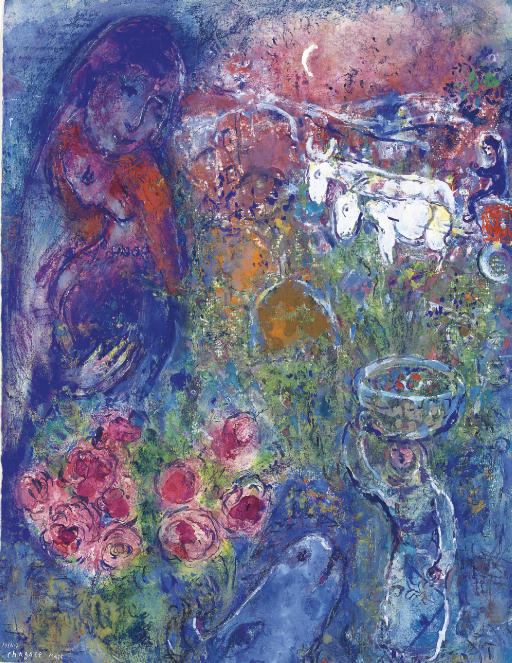
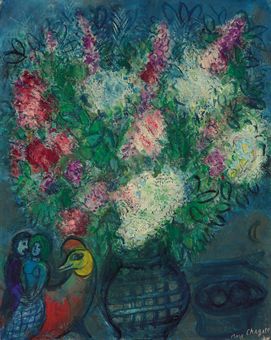
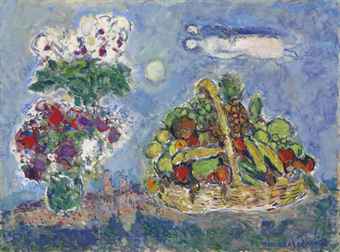
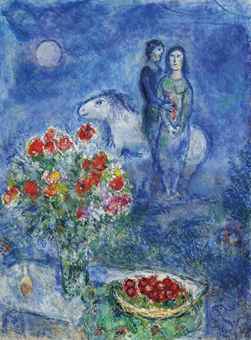
MARC CHAGALL FLEURS ET CORBEILLE DE FRUITS
Like many of his compositions, Chagall combines various vignettes in a single work to weave a complex tapestry of multiple narratives. Susan Compton writes, “When he was younger, Chagall disliked being told that his art was literary or even poetic, because he wanted to suppress narration in his work in favor of the means of expression... throughout his paintings Chagall introduces human beings, who may be arranged in an illogical manner, but who are constant reminders that art is above all a celebration of the humanity of mankind”.
In spite of his distaste for adherence to convention, the present work contains highly recognizable and beloved themes that repeatedly populated both the artist’s imagination and his paintings. Flowers, which dominate the foreground, fascinated Chagall from the late 1920’s onward. The artist was first struck by the charm of flowers in Toulon in 1924; he later claimed that he had not known of flowers in Russia and they therefore came to represent France for him.
The effervescent bursts of colour in the bouquet and the fruit basket add a note of levity to an otherwise somber composition. Life, growth and the cyclical nature of existence are underscored by their presence in the primary picture plane, perhaps a commentary on the scenes that lie deeper within the canvas. Young lovers are frequently featured throughout Chagall’s oeuvre, and comprise among the most important and symbolic of the cast of characters rendered in his paintings. The couple tenderly embraces as they linger on the border of the picture plane. Enveloped in their own world, they belong to neither the genre scene in the foreground nor the landscape behind.
The small village of Vitebsk, the artist’s birthplace in Russia, was most probably the inspiration for the humble cluster of rooftops set serenely beneath the moon.

MARC CHAGALL
1887-1985
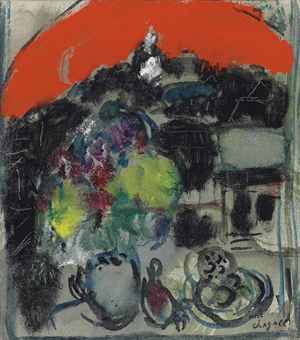
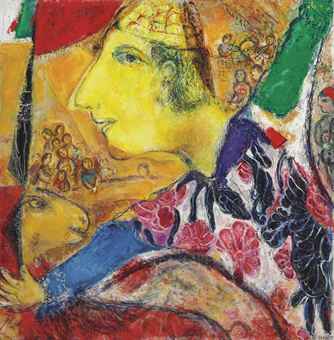
PEINTRE AU DOUBLE-PROFIL
SUR FOND ROUGE

MARC CHAGALL
1887-1985
L’ANE BLEU
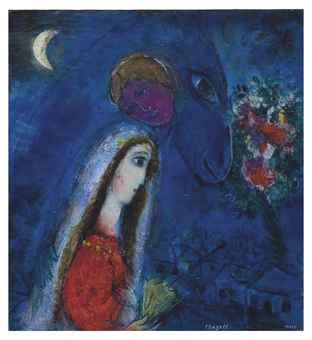
MARC CHAGALL
1887-1985
LA FIANCÉE RÊVANT
LA FIANCÉE RÊVANT

MARC CHAGALL
1887-1985
LES MARIÉS SOUS LE BALDAQUIN

MARC CHAGALL
1887-1985
ROI DAVID SUR FOND ROSE
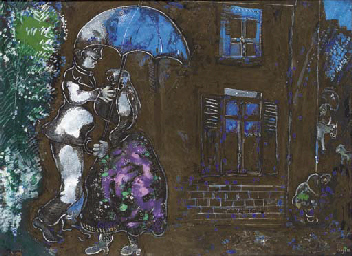
MARC CHAGALL
1887-1985
COUPLE SOUS LA PLUIE
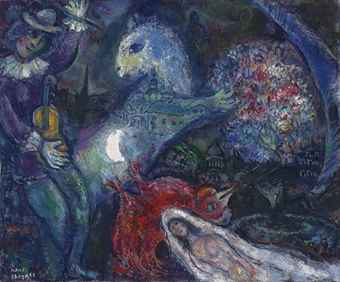
MARC CHAGALL
1887-1985
LA NUIT ENCHANTÉE
Christie's Art of The Surreal on 4 February 2015
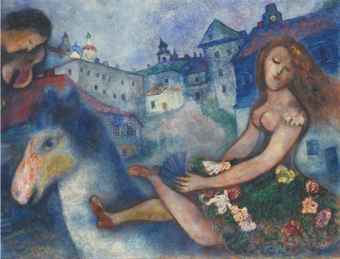
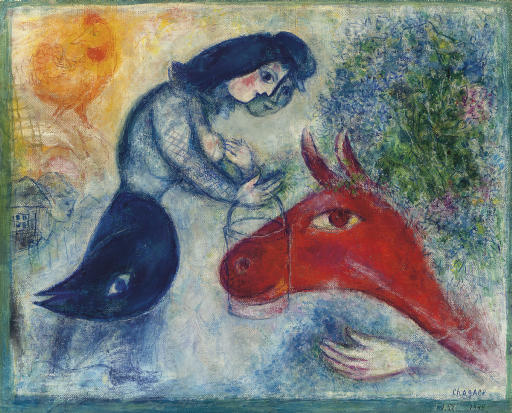
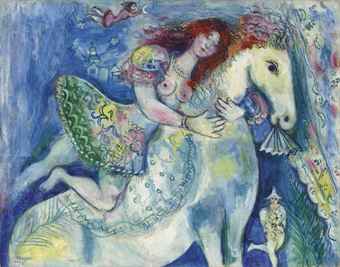
A beautifully composed painting that dates to a period of great happiness and stability for Marc Chagall, Jeune fille au cheval, 1927-1929, is offered at auction for the first time, having been acquired by A Private European Family almost 60 years ago (estimate: £2.2-2.8 million, illustrated right). A mirage of surreal and magical lyricism and blissful romance which encompasses Chagall’s favoured themes of love, memory, music and fantasy, Jeune fille au cheval exemplifies the artist’s unique and deeply personal artistic vision. Executed in iridescent, delicate colours and soft brushstrokes, it depicts a woman adorned in flowers sitting atop a horse emerging from a misty blue haze, while an airborne violinist plays across from her, with a rural street scene from Chagall’s beloved hometown, Vitebsk, beyond.
Chagall’s works from this period have a soothing, gentle atmosphere. Filled with flowers, lovers or fiddlers, they all exude a poetic harmony. In Jeune fille au cheval the components of the composition are unified through the delicate light, rich colours, and tender, romantic mood. The rich blue, dreamlike haze from which the image emerges could have developed from Chagall’s fascination with the French landscape, particularly the Côte d’Azur, which the artist had visited for the first time in 1926, three years before Jeune fille au cheval was painted. The gentle glow of light lends the painting a pictorial cohesion and compositional unity while evoking the fantastical, imaginary context.

Chagall’s works from this period have a soothing, gentle atmosphere. Filled with flowers, lovers or fiddlers, they all exude a poetic harmony. In Jeune fille au cheval the components of the composition are unified through the delicate light, rich colours, and tender, romantic mood. The rich blue, dreamlike haze from which the image emerges could have developed from Chagall’s fascination with the French landscape, particularly the Côte d’Azur, which the artist had visited for the first time in 1926, three years before Jeune fille au cheval was painted. The gentle glow of light lends the painting a pictorial cohesion and compositional unity while evoking the fantastical, imaginary context.
Christie’s Impressionist & Modern Art Evening Sale on Tuesday 2 February 2016

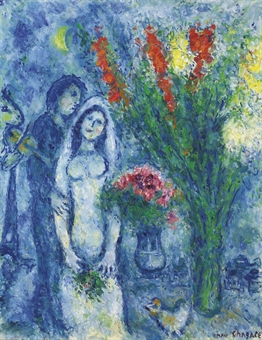
Acquired over 30 years ago, Les mariés de la Tour Eiffel by Marc Chagall (1887-1985) is one of the artist’s most romantic paintings of the 1920s, celebrating the love between the artist and his wife, Bella, as they entered a new phase of security and contentment in their lives (estimate: £4.8-6.8 million). Painted in 1928, the work features a double portrait of the couple as they tenderly embrace in the shadow of the Eiffel Tower. Their daughter Ida floats through an open window, which acts as a fluid boundary between the interior and exterior world, as she delivers a bouquet of flowers to the pair. Around the figures, a panoramic view of Paris reveals the gaiety of the city in the 1920s. Executed during a period of professional prosperity and personal comfort, the painting celebrates the strength of the familial bond between Chagall, his wife and their daughter, and the joy they felt together, as a family, in the pulsating and dynamic city of Paris in the twenties. The artist’s renewed happiness is reflected in the vivid, radiant hues employed, introducing sparkling shades of violet, green, mauve, blue, red and yellow to the composition, to achieve a complex interplay of colours across the canvas.
Christie's June 2015

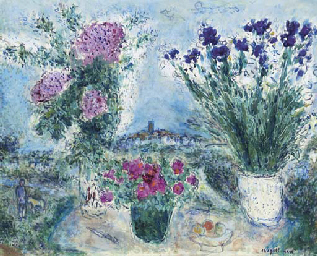
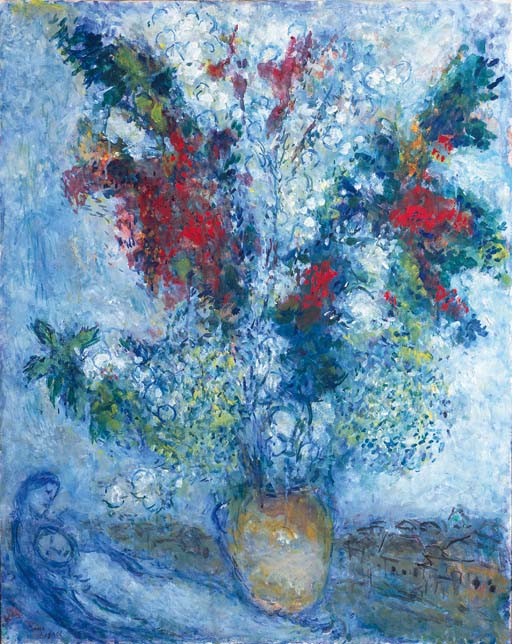
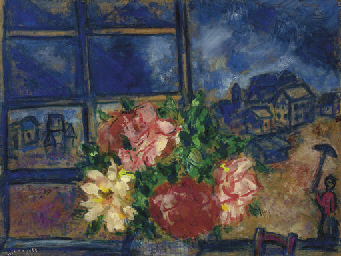
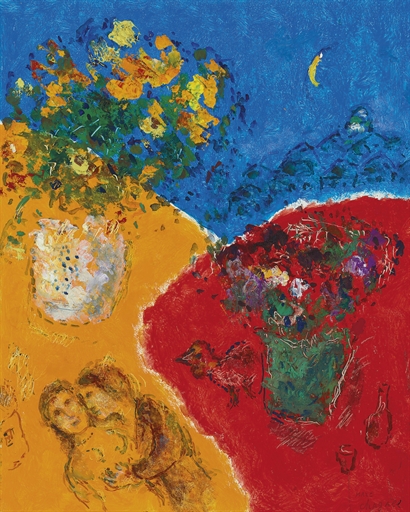
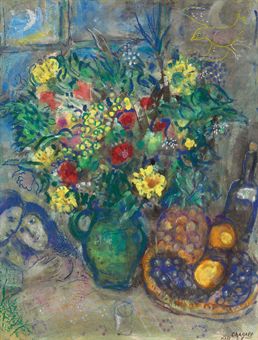
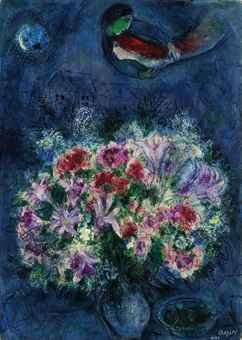
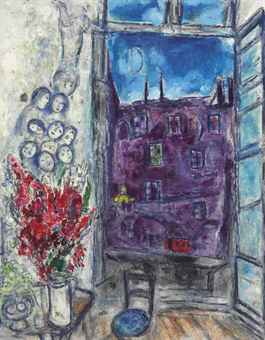
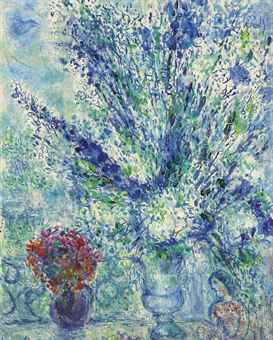
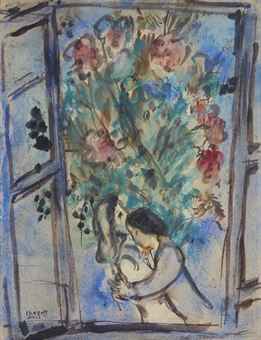
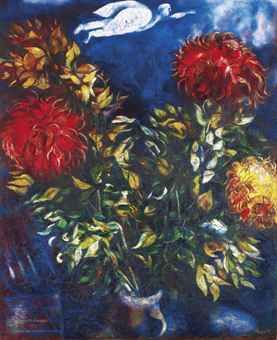
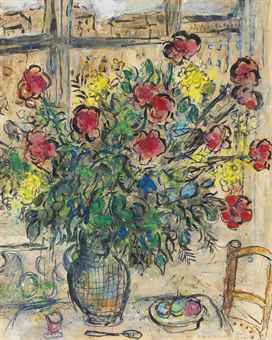
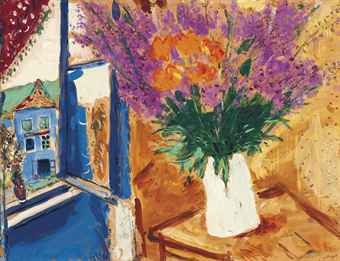
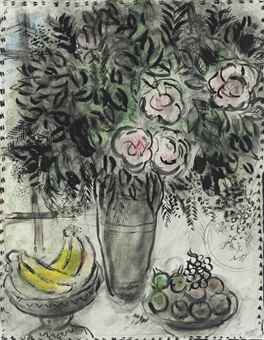
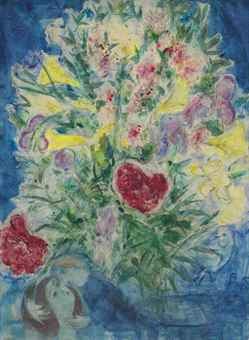
Painted from 1959 to 1960, Bouquet près de la fenêtre by Marc Chagall (1887-1985) has been identified as one of the finest flower paintings of this period by the author of the artist’s definitive biography and catalogue raisonné, Franz Meyer (estimate: £2.5 – 3.5 million). Acquired by the family of the present owner 35 years ago from Galerie Maeght in Paris, this monumental work presents the themes that dominated Marc Chagall’s painting throughout his career: romance, memory and nostalgia. Filled with light and colour, Bouquet près de la fenêtre reflects the peaceful Mediterranean idyll that was Chagall’s life at this time. Chagall had first introduced floral still-lifes in his paintings in the mid-1920s, having returned to France from his native Russia in 1923. He developed a new feeling for nature, and was particularly enchanted by flowers as the embodiment of the French landscape. Flowers also served as a potent symbol of love in Chagall’s work; the present work celebrates his love for Valentina or ‘Vava’ Brodsky, his second wife and last great love. Arranged like fragments of a dream, the various motifs of Bouquet près de la fenêtre appear as figments of Chagall’s imagination, memories from the artist’s past, and images of his present life, creating a new, fantastical reality.
Sotheby's 2014

LOT SOLD. 1,685,000 USD
Christie's June 2015
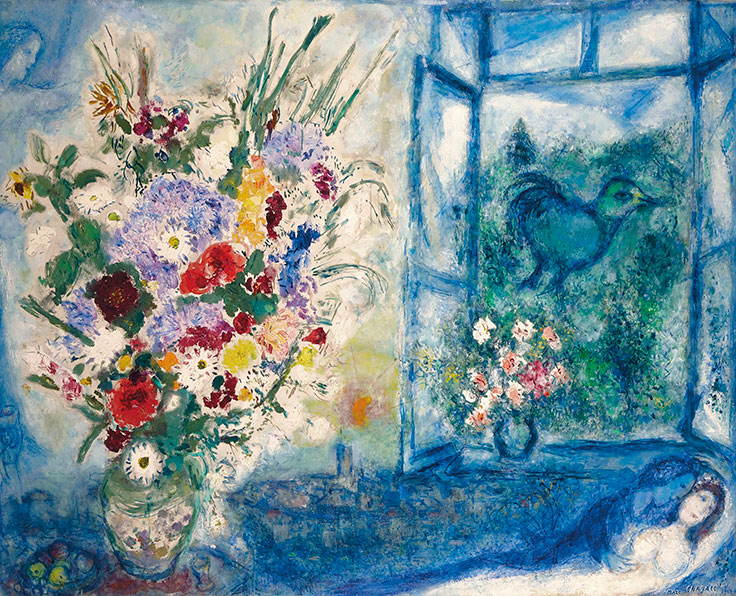
Painted from 1959 to 1960, Bouquet près de la fenêtre by Marc Chagall (1887-1985) has been identified as one of the finest flower paintings of this period by the author of the artist’s definitive biography and catalogue raisonné, Franz Meyer (estimate: £2.5 – 3.5 million). Acquired by the family of the present owner 35 years ago from Galerie Maeght in Paris, this monumental work presents the themes that dominated Marc Chagall’s painting throughout his career: romance, memory and nostalgia. Filled with light and colour, Bouquet près de la fenêtre reflects the peaceful Mediterranean idyll that was Chagall’s life at this time. Chagall had first introduced floral still-lifes in his paintings in the mid-1920s, having returned to France from his native Russia in 1923. He developed a new feeling for nature, and was particularly enchanted by flowers as the embodiment of the French landscape. Flowers also served as a potent symbol of love in Chagall’s work; the present work celebrates his love for Valentina or ‘Vava’ Brodsky, his second wife and last great love. Arranged like fragments of a dream, the various motifs of Bouquet près de la fenêtre appear as figments of Chagall’s imagination, memories from the artist’s past, and images of his present life, creating a new, fantastical reality.
Sotheby's 2014

LOT SOLD. 1,685,000 USD

LOT SOLD. 1,445,000 USD
Christie's 1999


Christie's 2006
Christie's 2007
Christie's 2008

Pr.£541,250($778,318)
2010


Pr.£457,250($684,046)

Christie's 2011



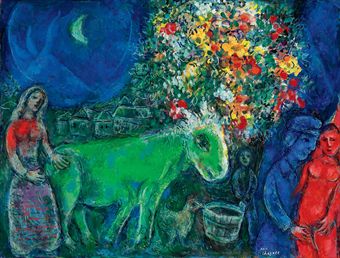
Marc Chagall (1887-1985)
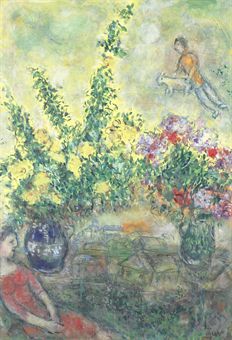
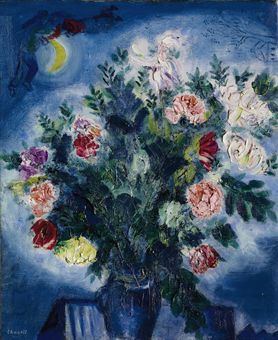
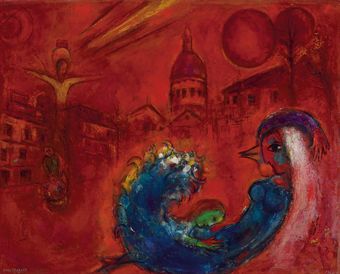

Christie's 2011
Christie's 2015

($453,900 -$756,500)
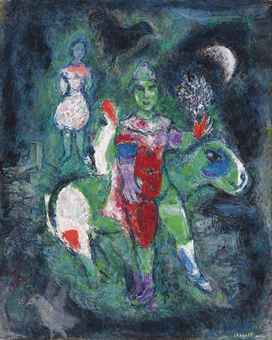
Marc Chagall (1887-1985)
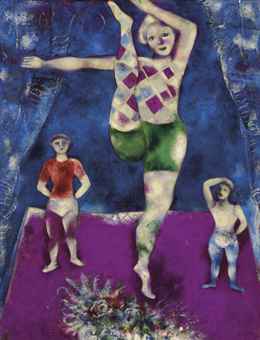
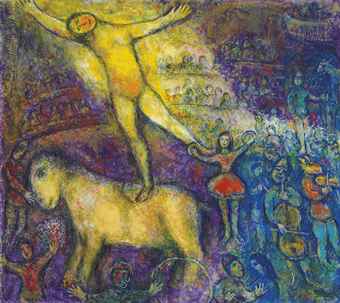


Christie's 2012
KOLLER ZURICH AUCTION June 26, 2015

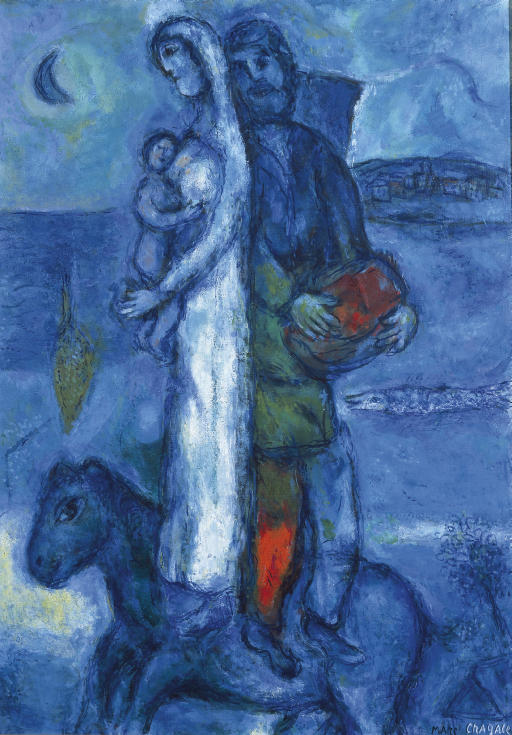
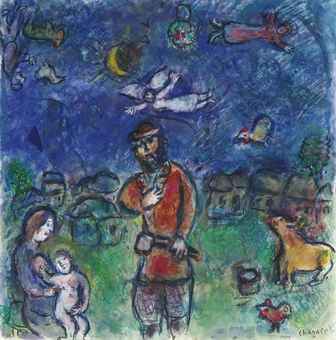
From the “painter poet” Marc Chagall comes “La famille du pêcheur”, an oil painting composed of shades of deep blue. Produced in 1968, it has been exhibited in major Chagall retrospectives such as at the Pushkin Museum in Moscow in 1987, at the Galleria d’Arte Moderna in Turin in 2004 and at the Museum of Art in Seoul. It will now be presented at Koller with an estimate of CHF 2.5 to 3 million.
Nhận xét
Đăng nhận xét